

The Future of Publishing and Edtech 2024: Monitoring and Managing Skills Gaps
Co-sponsored by Strategically Creative and ElevatED Consultants
By: Becky Hartnup and Robyn McKenna
Strategically Creative and ElevatED Consultants conducted a survey of publishing and education technology professionals, including senior decision makers, to map the critical areas where organisations are experiencing skills gaps, evaluate the business impact and identify the priority competencies for businesses looking to stay competitive.
This report outlines our findings and places them in a broader research context. It examines the factors driving skills gaps and evaluates strategies to address them.
The Big Picture
The landscape for publishing and edtech is rapidly evolving, with digital transformation continuing to shift focus and revenue from traditional business and emerging opportunities requiring businesses to rapidly adapt. The pandemic has fundamentally changed industry working practices, accelerated market transformation and driven technological advancements, leaving an environment of uncertainty and ongoing change.
Our survey builds on the Publishers Association Skills Report, and suggests skills gaps in publishing and edtech are:

Prevalent
100% reported skills gaps + 90% “high” skills gaps
Multiple Drivers
Digital Transformation being the most common driver
High Impact
Impacting employee motivation, competitiveness & revenue
Wide Ranging
Traditional and emerging skills are all affected
How are these Skills Gaps impacting businesses?
Survey respondents reported that skills gaps are impacting business in a variety of ways. The top 3 effects on their business are:
- Lost Revenue Opportunities
- Team Engagement & Motivation
- Losing Business to Competitors
According to Gallup’s State of the Global Workplace: 2023 Report, employees who are not engaged or who are actively disengaged cost the world $8.8 trillion in lost productivity. That’s equal to 9% of global GDP, which presents a strong case for investing in effective solutions.
How prevalent are skills gaps?
Every respondent reported skills gaps in their team or organisation, suggesting an impact that spans all functions, roles, and geographical territories. Most respondents (95%) reported “some” or “high” skills gaps in all six areas covered by the survey and gaps were reported in every individual skill within those areas. More than 90% of respondents reported “high” skills gaps. These were reported notably more frequently by respondents within Publishing compared to those in EdTech.
What are the biggest skills gaps in Publishing and Edtech?
The skills categories with the highest skills gaps were Self Management skills and Creative Entrepreneurship where, where two thirds (77%) and more than half (53%) respectively, reported “high” skills gaps.
100% of respondents stated Some+ Skills gap for Making Data-Driven Decisions
Workforce Skills Gap Report for Publishing and EdTech
With regard to specific skills there were some patterns. Utlising data is was the most notable problem area with 100% of respondents stating they had “Some” or “High” skills gaps in Making Data-Driven Decisions and 93% reporting gaps in Effective Use of Data. This is also reflected by gaps in Building Success Metrics and KPIs to Determine Process & Success of Business (96%). The introduction of technology has increased the availability of data for monitoring and decision making, making skills gaps more apparent.
Confidence working with data has become central to most functions, including those where data analysis was not traditionally a core skill.
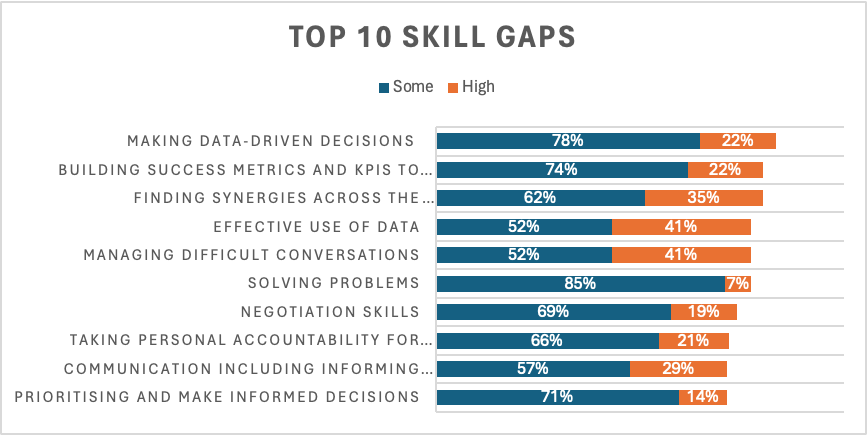
The top ten also suggest weaknesses in skills that are associated with a future facing mindset such as Finding Synergies Across the Organisation (97%), Solving Problems (92%), Taking Personal Accountability for Learning and Growth. There are also gaps in core communication skills which are essential in times of change, with 93% reporting gaps in Managing Difficult Conversations and 88% in Negotiation Skills (88%).
The skills appearing in the Top 10 skills gaps are all in demand skills by organisations and are linked to a forward-looking approach. By understanding the gaps and nurturing these areas, businesses can build a learning culture with teams and individuals that can meet the demands of a rapidly evolving market.
What are the factors driving skills gaps in Publishing and Education?
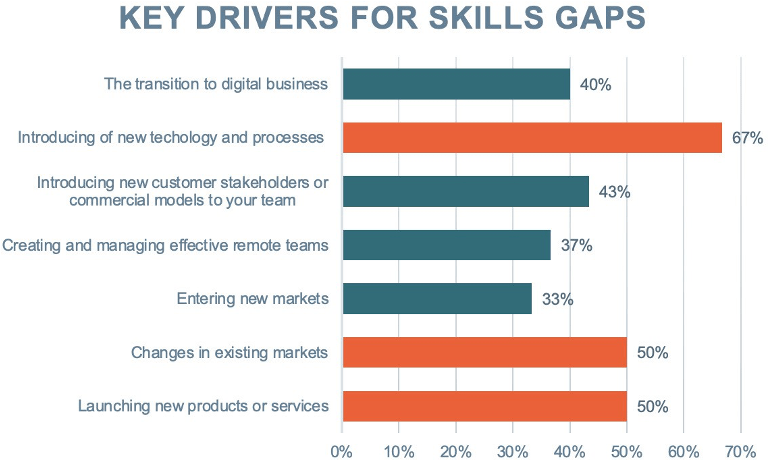
While the survey indicated that a range of factors are responsible for skills gaps in the publishing and educational technology sector, the number one driver is Introducing New Technology and Process (67%). Best practice and adoption of new technology varies across the publishing and EdTech industry.
The focus on AI tools has led to rapid adoption of new technologies which has outpaced employee capabilities.
Investment in technology is often a response to external changes in the market and the introduction of new solutions to meet those needs. These areas are critical for personal and organisational success, particularly in an industry undergoing rapid digital transformation. Research from the World Economic Forum echoes sentiment, and Deloitte’s 2024 Human capital trends report highlights that technological disruption and automation are continually reshaping job roles, requiring workers to upskill and reskill more frequently. Additionally, the ongoing digital transformation within industries, including publishing and edtech, demands a workforce proficient in new technologies and adaptable to change.
In addition to technology being a key driver, 50% of the respondents reported Changes in Existing Markets and Launching New Products and Services as contributing factors to their skills gaps. While it is essential to respond to customer needs, a reactive approach that is not supported with training and development can lead to employee fatigue and a less competitive position.
What are the factors driving skills gaps in Publishing and Education?
Respondents ranked the skills categories based on their importance to their organisation. There was little difference between the highest ranked (Interpersonal Skills with 19% of all points) and the lowest ranked (Creative Entrepreneurship skills with 13% of all points). Most companies require a mix of skills essential to ensuring their success in the future
| Skills Category | Overall Ranking |
| Interpersonal Skills | 1 |
| Leadership & Management Skills | 2 |
| Self-Management Skill | 3 |
| Tech use and Development Skills | 4 |
| Digital Business Skills | 5 |
| Creative Entrepreneurship Skills | 6 |
Leadership and Management skills were ranked second in importance. Many companies invest in bespoke training for their leaders and managers which may explain why none of the specific Leadership and Management skills appeared in the Top 10 most prevalent skills gaps.
How are Publishing and Edtech organisations managing Skills Gaps?
Our survey indicates that many companies rely heavily on generic online training platforms to address skills gaps. Most pick this option because of the ease of implementation, low costs, and scalability of the solution.
However, respondents noted that online training alone is often less effective, engaging, and impactful for their teams. According to the Association for Talent Development, organisations with comprehensive training programs have 218% higher income per employee and a 24% higher profit margin than those with less robust training initiatives.
What are some effective ways of targeting skills gaps?
Enhancing training approaches requires more than just offering one-size fits all courses. With the rapid pace of change in the publishing and EdTech sectors, it’s crucial to provide learning opportunities that are flexible, engaging, and relevant to your workforce.
Blended Learning Models
Integrating tailored online training with personalised coaching and practical applications creates a more comprehensive and impactful learning experience. Online modules allow learners to engage with content at their own pace, providing flexibility and accessibility. Combining this with personalised coaching sessions ensures individuals – or teams – explore the most effective ways to apply what they’ve learned directly to their role.
Gamification
By incorporating Real-World Examples, Role Play Exercises Applications and Simulations Training programs you encourage learners to practice applying skills such a decision-making, problem-solving, and critical thinking to real-world scenarios in a controlled environment. This helps them move through the discomfort of changing their behaviour and gives them confidence to incorporate new skills into their job.
Fostering a Continuous Learning Culture
Develop a culture of continuous learning, combining bite-sized learning opportunities, collaborative learning and peer mentorship. People learn best when learning is embedded in context and they can discuss, reflect, and apply new knowledge within a community. This can be incorporated into team-based projects, discussion forums, and peer mentorship programs.
Summary
There is no one-size-fits-all solution for addressing skills gaps. Each team and individual has unique needs, and a flexible approach is essential. Providing employees with a variety of learning options and encouraging self-directed development can effectively bridge skills gaps and support our organisation’s growth.
Your training needs will continue to evolve alongside the dynamic publishing and edtech landscape. If you are concerned about skills gaps don’t let them impact your business. Reach out to us for an initial exploratory chat and let’s start tackling these skills gaps together.
- Team development workshops – design & facilitation
- Customised blended or online learning for teams
- Team and leadership coaching


Methodology of Survey
The survey included a balanced representation from the publishing and edtech sectors, with an equal 50/50 split. Responses were gathered from a wide range of departments, including Sales, Marketing, Finance, Technology, General Management, and Product. Respondents spanned various organizational levels, from C-suite executives to non-managers. This diverse representation provides a comprehensive view of skills gaps at different levels of responsibility. The survey captured responses from all major regions, including North America, Latin America, EMEA, APAC, and Australasia. Approximately a quarter of respondents had global responsibilities, suggesting that the findings reflect both regional and global perspectives.
 ElevatED Consultants